
There are few places on earth that combine sun-drenched coastlines, ancient ruins, dramatic landscapes, and decadent food and wine quite like Sicily. On a recent romantic trip for two, we decided to circumnavigate the island. We planned a slow, immersive drive full of unforgettable moments, hidden hill towns, sea views, and candlelit dinners.
Starting in Catania and winding our way around the island clockwise, here’s how we fell in love with Sicily—and with each other—all over again.
The Beginning of the Journey: Catania
We landed in Catania, and gave ourselves a full day to soak in the energy of this baroque coastal city. After checking into a small boutique hotel near Piazza del Duomo, we wandered around the city, admiring the way that gritty and majestic comingled at every turn. Catania is a sometimes lovely, sometimes industrial, sometimes commercial and sometimes agricultural place, the second largest city on Sicily. We eventually found ourselves wandering through the buzzing La Pescheria fish market. Here locals barter over the catch of the day and the scent of salt and citrus fill the air.

That night, we sat in an elegant sidestreet patio beneath strings of lights and hundreds of colorful umbrellas at one of the street-side cafes along Via Santa Filomena. We dined al fresco on spaghetti ai frutti di mare, a seafood pasta made with whatever was fresh that day. We sipped local red wine and watched as Catania was alive around us. It was the perfect way to begin a trip that promised romance and adventure at every turn.

Ortigia and Ancient Syracuse
After a day enjoying the bustle of the city, we collected our rental car, and headed south toward the elegant coastal city of Syracuse (Siracusa), already in love with Sicily’s rhythm.
Once one of the most powerful cities in the ancient Mediterranean, Syracuse is a captivating blend of history, sea air, and Sicilian charm. The city’s heart lies on the island of Ortigia, a UNESCO World Heritage site and a compact gem connected to the mainland by a short bridge. Here are golden Baroque buildings, winding alleys, lively piazzas, and the stunning Duomo di Siracusa. This cathedral is built over the ruins of a Greek temple, and you can see both as you stroll through. Just steps away, the sea laps against the island’s edge, and seafood restaurants spill onto the promenade. Enjoy the day’s catch with a side of sunset.
The Neapolis Archaeological Park holds the remnants of ancient Syracuse’s former glory. Visit the massive Greek Theatre, the Roman Amphitheatre, and the mysterious Ear of Dionysius—a cave legendary for its acoustics. Whether you’re wandering ancient ruins, sipping wine in a sun-drenched piazza, or watching fishing boats bob in the harbor, Syracuse weaves together past and present in a way that’s both deeply moving and effortlessly beautiful.

Nero d’Avola in Avola
Just south, we made a quick detour to Avola, home of the famed Nero d’Avola wine. We visited a small, family-run winery in town, and stayed at another overnight. The latter was nestled among olive trees, where we enjoyed a private tasting. Sipping rich red wine in the shade of a vineyard pergola, surrounded by silence and sun, was pure Italian romance. That night we retired to a lovely villa room with a balcony overlooking the olive orchard.
Noto and Ragusa – Baroque Dreams & Hilltop Charm
From Avola, we drove south to Noto, Sicily’s baroque jewel. Noto is a Baroque masterpiece bathed in honey-colored stone and golden light. After a devastating earthquake in the 17th century, the town was completely rebuilt in a unified architectural style. The result is elegant palazzos, sweeping staircases, and intricately carved facades that seem to glow at sunset. The centerpiece is the majestic Noto Cathedral, rising above the lively main street, Corso Vittorio Emanuele. Here locals take evening strolls and cafes spill out onto the sidewalks. It’s a place to slow down, savor a granita, and soak in the charm of this beautifully preserved town.

Next, we made our way to Old Ragusa (Ragusa Ibla). The drive itself was stunning—winding roads and stone bridges across dramatic ravines. The town of Ragusa Ibla is a hillside maze of narrow lanes, stone staircases, and beautifully restored Baroque buildings. After a devastating earthquake in 1693, the town was rebuilt in layers. Today Ibla feels like a living postcard—quiet, romantic, and rich with atmosphere. At its heart is Piazza Duomo, where the elegant Cathedral of San Giorgio presides over a square lined with cafes and locals enjoying their evening passeggiata. It’s a place that invites wandering. Every corner reveals a new view, a hidden courtyard, or a glimpse into everyday Sicilian life.


Agrigento and the Stairway to Heaven
Next, we headed west to the Valley of the Temples in Agrigento, one of the most majestic archaeological sites in all of Europe. Standing among towering Doric columns that have survived for over 2,000 years was humbling and awe-inspiring.

We stayed overnight in Agrigento and spent the next morning at the Archaeological Museum. There was so much information about the city’s ancient Greek roots and original statues and artifacts.
In the afternoon, we made our way to the Scala dei Turchi, the white limestone “staircase” along the coast. We walked barefoot along its smooth, natural terraces and watched the sun melt into the sea—an unforgettable golden moment.

Selinunte

On Sicily’s southwestern coast, Selinunte offers one of the most expansive and awe-inspiring archaeological sites in all of Europe. Once a powerful ancient Greek city, today it’s a windswept landscape of massive temple ruins, crumbling stone walls, and wild grasses overlooking the sparkling Mediterranean Sea. The scale here is staggering. Plan accordingly, because it takes some time to walk the entire site. Temple E, partially reconstructed, gives a striking sense of the grandeur that once defined the city. Most of the other temples lie in romantic disarray, their fallen columns scattered like ancient puzzle pieces. You’ll want good walking shoes and a sense of adventure.

Unlike more crowded sites, Selinunte often feels like a secret waiting to be discovered. You can walk freely among the ruins, climb over ancient stones, and let your imagination roam across centuries of history. With the sea breeze in your hair and the scent of wild herbs in the air, Selinunte is both haunting and humbling. Its a vivid reminder of how empires rise and fall, and how beauty endures in the silence that follows.

Castelvetrano and Agriturismo Bliss
After our time in Agrigento, we made a slow, scenic drive to Castelvetrano, nestled inland among olive groves and vineyards. Here, we stayed at a quiet agriturismo—a rustic yet refined countryside farmhouse. We and a few other travelers we were treated to home-cooked Sicilian dishes made with ingredients grown right outside our window.
The peacefulness, the stars overhead, and the scent of wild herbs in the air made it feel like we had discovered a hidden world all our own.

Ancient Segesta
Tucked into the rolling hills of western Sicily, Segesta is a hauntingly beautiful archaeological site that feels almost suspended in time. The star of the site is its remarkably well-preserved Doric temple. It stands proudly on a hilltop amid wildflowers and sweeping countryside. Just a short shuttle ride (or a steep but scenic walk) away, there’s the ancient Greek theater perched dramatically on another hillside, offering panoramic views all the way to the sea. Unlike more crowded ruins at Agrigento and Syracuse, Segesta feels quiet and contemplative.
Eve though less remains at Segesta than at Selinunte, it is a place to wander and imagine the ancient world. And take in the raw natural beauty that surrounds it. It’s an ideal stop for history lovers or anyone seeking a serene, off-the-beaten-path slice of Sicily.


Marsala and the Salt Pans
We then drove west to Marsala, where the famed fortified wine originates. After a tasting of the famous marsala wine, we did some serious shopping in town.

Just north we explored the Stagnone Lagoon and its surreal salt flats. The area is dotted with ancient windmills and mounds of white sea salt. The tour of the ancient facility is excellent and far exceeded my expectations. Our tour guide was actually the granddaughter of the modern owners and she was so knowledgeable. This is not just a tourist trap, but a place of family history. The light here is magical—rosy and soft, especially at sunset.


Camporeale – Connecting to My Roots
Arriving in Camporeale from the west felt like crossing into my own personal history. The town sits quietly in the rolling hills just south of Palermo, far from Sicily’s coastal bustle, and visiting it carried a personal weight—it’s the place my mother’s grandparents once called home. Camporeale is nestled in gentle rolling hills, with open views of the surrounding countryside, and a sense of connectedness to the land that feels deeply rooted. Standing there, it was easy to imagine generations shaped by the same land, light, and rhythms that still define daily life today.
The local economy remains closely tied to agriculture, with vineyards and olive groves stretching outward in every direction. Wine and olive oil are more than products here; they are expressions of identity and survival, anchoring the town to centuries-old traditions. At the heart of Camporeale, the church rises as both a spiritual and social landmark, its presence grounding the town’s communal life. Nearby, larger-than-life murals burst across building facades, depicting history, labor, and faith in bold color and scale. These works transform ordinary streets into open-air galleries, blending reverence for the past with a distinctly contemporary voice—much like Camporeale itself.


Coastal Charm in Cefalù
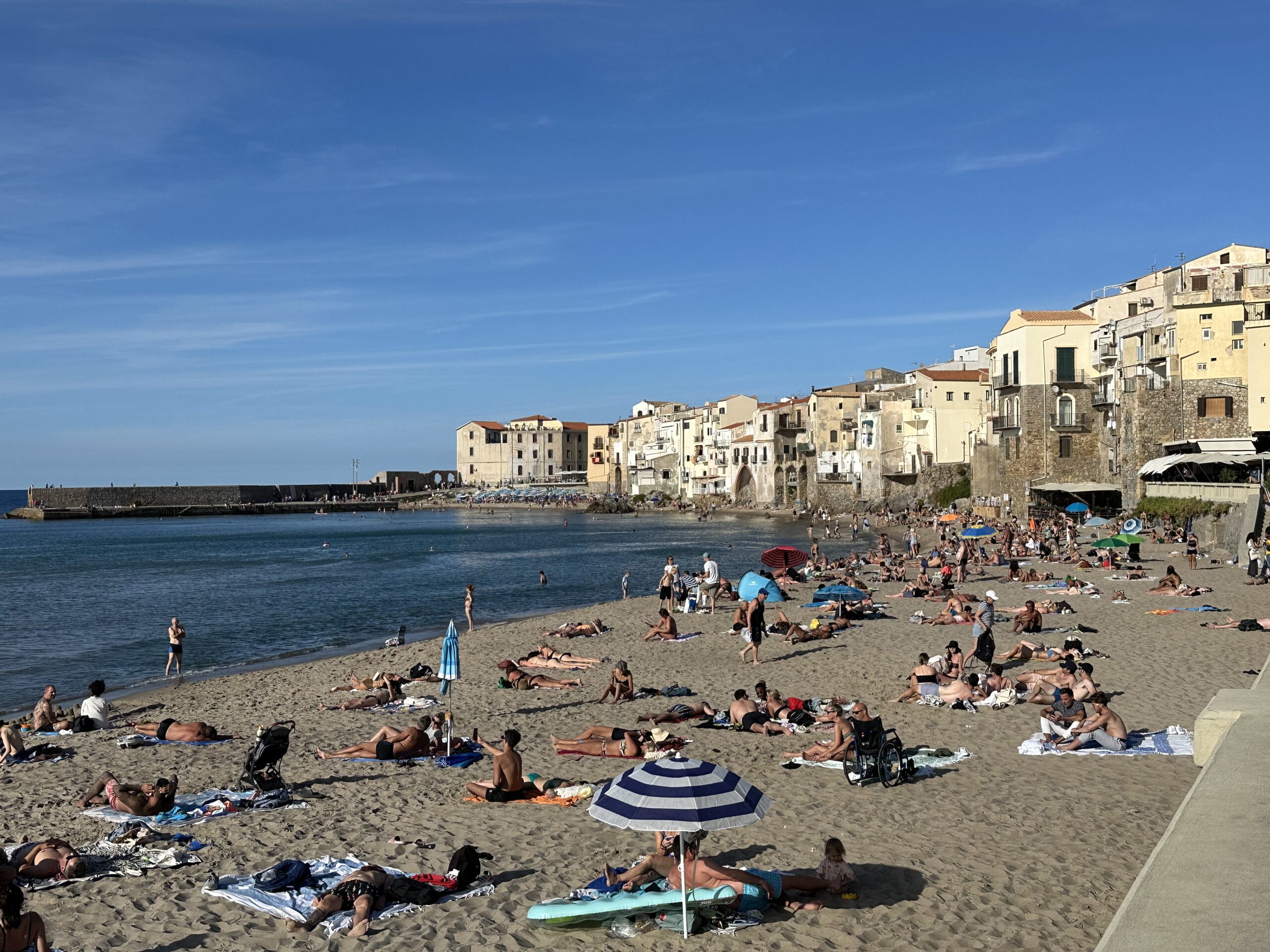
Heading north along the coast, we arrived in Cefalù, a postcard-perfect town with a medieval core and sandy beaches. Nestled between the turquoise waters of the Tyrrhenian Sea and the towering cliffs of La Rocca, Cefalù feels both timeless and welcoming. With its golden sandy beach stretching along the historic center and fishing boats bobbing in the harbor, Cefalù invites you to slow down and soak in the coastal rhythms of Sicilian life. It’s the kind of place where mornings begin with a cappuccino in a sunny piazza and afternoons are best spent with your toes in the sand or wandering narrow cobbled streets in search of gelato.
At the heart of town stands the magnificent Duomo di Cefalù, a Norman cathedral commissioned in the 12th century by Roger II. Its twin towers dominate the skyline. But step inside to find one of Sicily’s most stunning mosaics. It is a golden Christ Pantocrator gleaming from the apse, surrounded by intricate Byzantine art. The cathedral, with the dramatic backdrop of La Rocca rising behind it, is an unforgettable sight. And a powerful testament to the island’s layered history.
Cefalù also offers great opportunities for shopping and leisurely exploring. There are small boutiques selling handmade ceramics, local olive oil, Sicilian linens, and stylish beachwear. The town has just the right balance of authenticity and charm—lively, but never overwhelming. Whether you’re climbing La Rocca for sweeping views, dining seaside as the sun dips into the sea, or simply strolling the lantern-lit streets after dark, Cefalù captures the essence of Sicilian warmth and beauty.

Climbing Mount Etna
No trip around Sicily could be considered complete without visiting its fiery heart: Mount Etna. We booked a guided hike up the crater trails. You can feel the crunch of volcanic ash beneath your boots and the crisp air in your lungs. Due to the amount of activity, no tours are allowed to go to the summit. In fact, the entire time we were visiting Sicily, there was a constant stream of volcanic smog coming from Etna. The hike was still amazing, and our guide was very knowledgeable about the various geologic formations. There were vents, magma chambers and fumaroles dotting the entire landscape.


Taormina – The Jewel of Sicily
As we always do, we saved the best for last. Perched high above the Ionian Sea on the eastern coast of Sicily, Taormina is often called the most beautiful place on the island. And with good reason. With its sweeping views of Mount Etna, medieval streets draped in bougainvillea, and an atmosphere that’s both elegant and effortlessly relaxed, Taormina feels like a dream you don’t want to wake from. The town cascades along the hillside in layers of history, charm, and jaw-dropping scenery. It offers that rare combination of natural beauty and cultural richness that captures your heart instantly.
At the center of Taormina’s magic is the Ancient Greek Theater. We have seen dozens of ancient theatres, but this has the most spectacular settings of its kind in the world. It was carved into the rock in the 3rd century BC and later expanded by the Romans. The theater overlooks the sea with Mount Etna smoldering in the distance. Even if you’re not catching a concert or a performance, just sitting on its ancient stone steps as the sun sets over the coastline is an unforgettable experience—timeless and cinematic.
Shopping in Taormina
But Taormina isn’t just about ancient ruins and scenic vistas. It’s also one of Sicily’s best spots for shopping. Corso Umberto—the town’s stylish main street— is lined with chic boutiques, artisan shops, and glittering jewelers. Here, you can find everything from handcrafted ceramics and locally made leather goods to high-end Italian fashion and designer sunglasses. Duck into the side alleys and you’ll stumble upon art galleries, wine shops, and cafes offering delicious granita and cannoli.
Whether you’re sipping an aperitivo with a view, wandering ivy-clad alleyways, or splurging on a perfect pair of Italian sandals, Taormina wraps you in beauty at every turn. It’s romantic, timeless, and impossibly picturesque. A place where the past and present mingle with the scent of citrus in the air. If Sicily were a crown, Taormina would be its brightest gem.


Final Thoughts: Sicily for Two
Sicily wrapped us in its arms—its sunshine, flavors, landscapes, and stories. This isn’t just a vacation. It is a journey through time and beauty, one winding road and shared sunset at a time.
If you’re looking for a destination that blends passion, history, adventure, and pure joy, circumnavigating Sicily as a couple is unforgettable. It will leave you full—not just from the food—but from the feeling that you truly lived.