
Tucked along the Danube River, where Slovakia meets Austria and Hungary, Bratislava is a capital that delights with its contrasts. One moment you’re walking beneath medieval gate towers. The next you’re sipping coffee in a minimalist café tucked inside a 1960s-era building. It’s a city where old meets new in seamless, walkable harmony. And best of all, you can explore most of it in just a couple of days.
Whether you’re coming from Vienna, Budapest, or just exploring Slovakia itself, here’s a guide to everything you should see and do in Bratislava.

Start in the Old Town (Staré Mesto)
Bratislava’s Old Town is compact, colorful, and buzzing with life. Begin your visit here, where cobbled streets weave past baroque palaces, pastel facades, and lively plazas filled with café tables.
Don’t miss:
- Michael’s Gate: The last preserved medieval gate into the city, with great views from the top.
- Main Square (Hlavné námestie): The heart of the Old Town, where you’ll find the Old Town Hall and the iconic Roland Fountain.
- Primatial Palace: A pale pink neoclassical palace with elegant halls and hidden courtyards.
- Quirky statues: Keep an eye out for Bratislava’s strange and beloved bronze statues, like Čumil, the “Man at Work” peeking out of a manhole, or the Schöner Naci, a top-hatted local legend who wandered the city greeting strangers.


Climb Up to Bratislava Castle
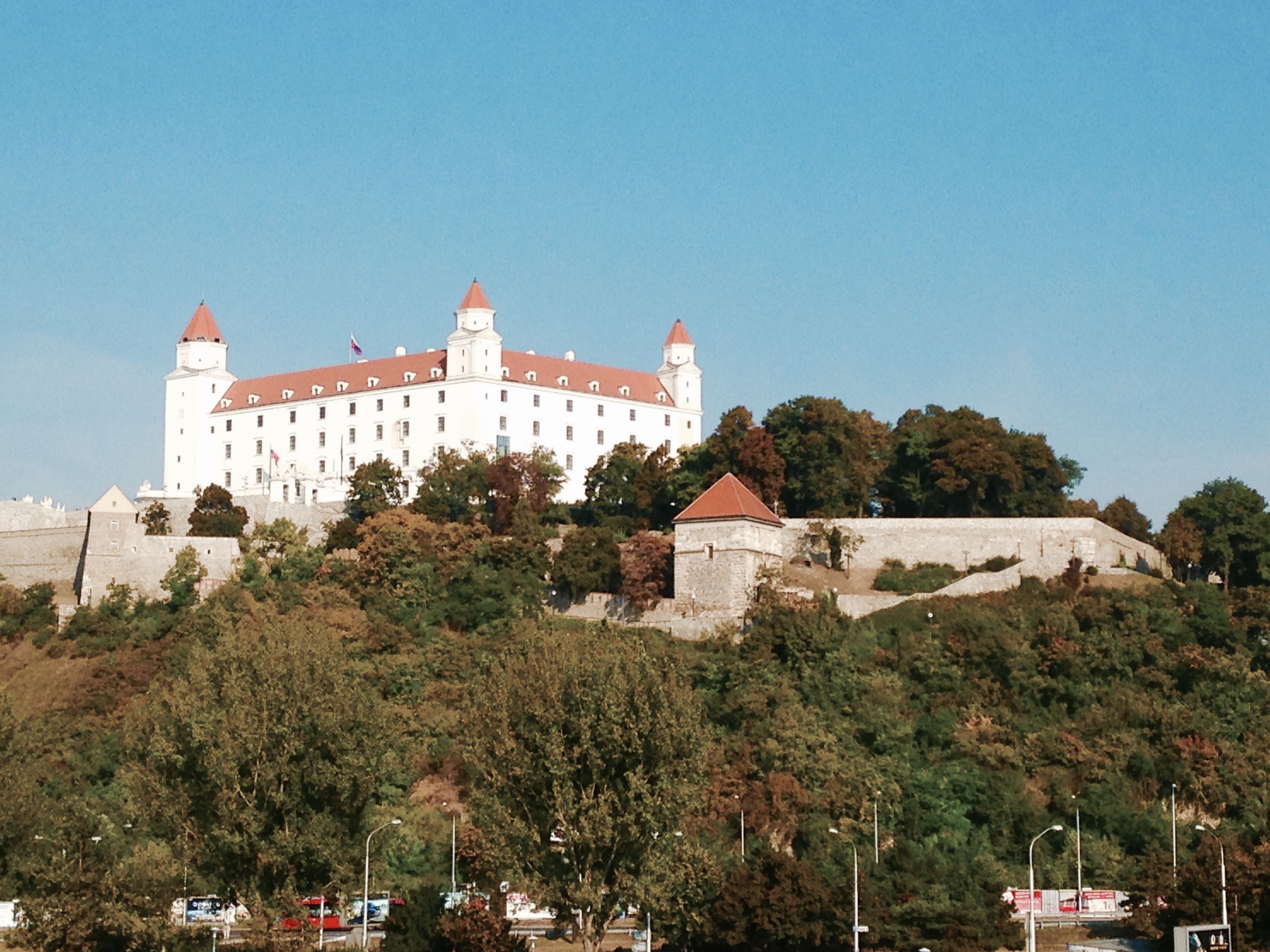
Towering above the Danube on a hill, Bratislava Castle is the city’s most iconic landmark. It’s not a fairytale spire-style castle, but a sturdy white fortress with four square towers, a sweeping terrace, and panoramic views over the city, the river, and into Austria on a clear day.
Inside, the castle hosts historical exhibitions from the Slovak National Museum. Even if you don’t go inside, the grounds are perfect for a peaceful walk or a picnic with a view.


Walk the Danube Promenade and the UFO Bridge
The Danube River cuts through the city and offers one of the most scenic urban walks. Follow the promenade toward the striking UFO Bridge (Most SNP). This is a Soviet-era masterpiece that looks exactly like a flying saucer perched on a single pylon.
For a small fee, take the elevator to the UFO Observation Deck, 95 meters above the river, for the best view in town. There’s also a restaurant and bar if you want to linger over a drink with a sunset skyline.

Visit St. Martin’s Cathedral
Just below Bratislava Castle, St. Martin’s Cathedral is the city’s most important Gothic church. Here was the site of coronations for Hungarian kings and queens in the 16th–19th centuries. Look for the golden crown atop the spire—a symbol of its royal past. The interior is atmospheric, with stained glass, high vaulted ceilings, and quiet chapels.

Explore the Blue Church
Arguably Bratislava’s most Instagrammable building, the Church of St. Elizabeth, known as the Blue Church, looks like it belongs in a candy-coated fairy tale. The exterior and interior are both powder blue, with Art Nouveau curves and intricate mosaic details. It’s a short walk from the Old Town, and it’s worth it even if just to snap a photo.


Experience the City’s Café Culture
Bratislava has a fantastic café scene that blends traditional and modern. Whether you want to sip espresso in a baroque courtyard or enjoy vegan cake and pour-over coffee in an industrial-chic space, you’ll find plenty of cozy stops.
A few favorites:
- Urban House – hip, spacious, and good for brunch or cocktails.
- Mondieu – for rich hot chocolate and beautiful pastries.
- Štúr Café – named for the Slovak national hero, it feels literary and old-world.
- Kaffee Mayer – a classic Viennese-style café for old-school cakes and elegance.

The Quirky Bronze Statues of Bratislava
One of the most unexpectedly delightful things about exploring Bratislava is spotting its whimsical bronze statues tucked into street corners, peeking out of the pavement, or leaning casually on park benches. They’ve become beloved local landmarks and selfie magnets, each with its own bit of personality and backstory.
Here are a few you shouldn’t miss:
- Čumil – The Watcher.
Possibly the most famous of them all, Čumil is a man popping out of a manhole cover in the middle of a cobblestone street, resting his chin on folded arms with a mysterious smile. Some say he’s a cheeky sewer worker; others think he’s peeking up skirts. Either way, he’s become a symbol of Bratislava’s playful spirit. You’ll find him at the corner of Panská and Rybárska brána. - Schöner Náci – The Gentleman.
Just steps from Čumil, you might see a tall man in a top hat tipping it politely to passersby. This is Ignác Lamár, a real-life figure from the early 20th century known for walking the streets of Bratislava dressed elegantly, greeting everyone with a smile and bow. The statue honors his kindness and eccentric charm. - Napoleon’s Soldier.
Leaning casually on a bench in the Main Square, this relaxed bronze figure represents a Napoleonic soldier, a nod to the French occupation of the city in the early 1800s. Tourists love to sit beside him for a photo—or sneak a kiss on the cheek. - Paparazzi.
Although this statue has been moved from its original location, it used to depict a photographer sneaking around a corner with a long camera lens. It was a playful jab at modern celebrity culture and Bratislava’s growing popularity as a tourist destination. Some versions or replicas can still be seen at themed cafés.
These statues add a sense of humor and humanity to the city’s historic backdrop. Hunting for them becomes a fun little game as you explore. Locals love them, and travelers often end up with a whole album of statue selfies by the end of their visit.


Check Out the Slovak National Gallery and Museums
If you’re interested in art and history, Bratislava offers a handful of cultural gems:
- Slovak National Gallery (SNG): Recently renovated, this riverside gallery blends classic Slovak art with modern exhibitions.
- Bratislava City Museum (in the Old Town Hall): Learn about the city’s past—and climb the tower for another great view.
- Museum of Arms (inside Michael’s Gate): Small but fun, especially if you like armor and swords.
Cross Over to Petržalka
For something a little different, cross the river to the Petržalka district—once a showpiece of Communist-era urban planning. It’s full of concrete housing blocks, but there’s a certain gritty charm to it, especially when contrasted with the picturesque Old Town.
From here, you can take a riverside walk, rent a bike, or visit Sad Janka Kráľa, one of the oldest public parks in Central Europe.
Take a Trip to Devín Castle
About 20 minutes outside the city center, Devín Castle is perched on a dramatic cliff above the confluence of the Danube and Morava rivers. The ruins are romantic and windswept, and the site offers sweeping views into Austria. It’s a great half-day escape and can be reached by bus, bike, or even riverboat in warmer months.
Eat Local: Slovak Comfort Food
Slovak cuisine is hearty, rustic, and delicious—especially in winter. Make sure to try:
- Bryndzové halušky: potato dumplings with sheep cheese and bacon.
- Kapustnica: sauerkraut soup with sausage, mushrooms, and sometimes prunes.
- Pirohy: filled dumplings (similar to pierogi), often served with sour cream.
- And of course, pair it all with a local Slovak beer.
Traditional restaurants like Slovak Pub, Zylinder, or Modrá Hviezda are great places to sample local specialties.
Final Tips for Visiting Bratislava
- Getting there: Bratislava is just 1 hour from Vienna by train, bus, or boat. It also has its own international airport.
- Getting around: The city is extremely walkable. Trams and buses are efficient if you’re going farther out.
- Language: Slovak is the official language, but English is widely understood in tourist areas.
- Currency: Slovakia uses the euro (€).
Bratislava may not be Europe’s biggest or flashiest capital, but that’s exactly its charm. It’s stylish yet relaxed, rich with history but unpretentious, and filled with little surprises around every corner—like whimsical statues, unexpected views, or a freshly baked pastry tucked into a shop window.
Spend a couple of days here, and you’ll see why it’s one of Central Europe’s most underrated gems.