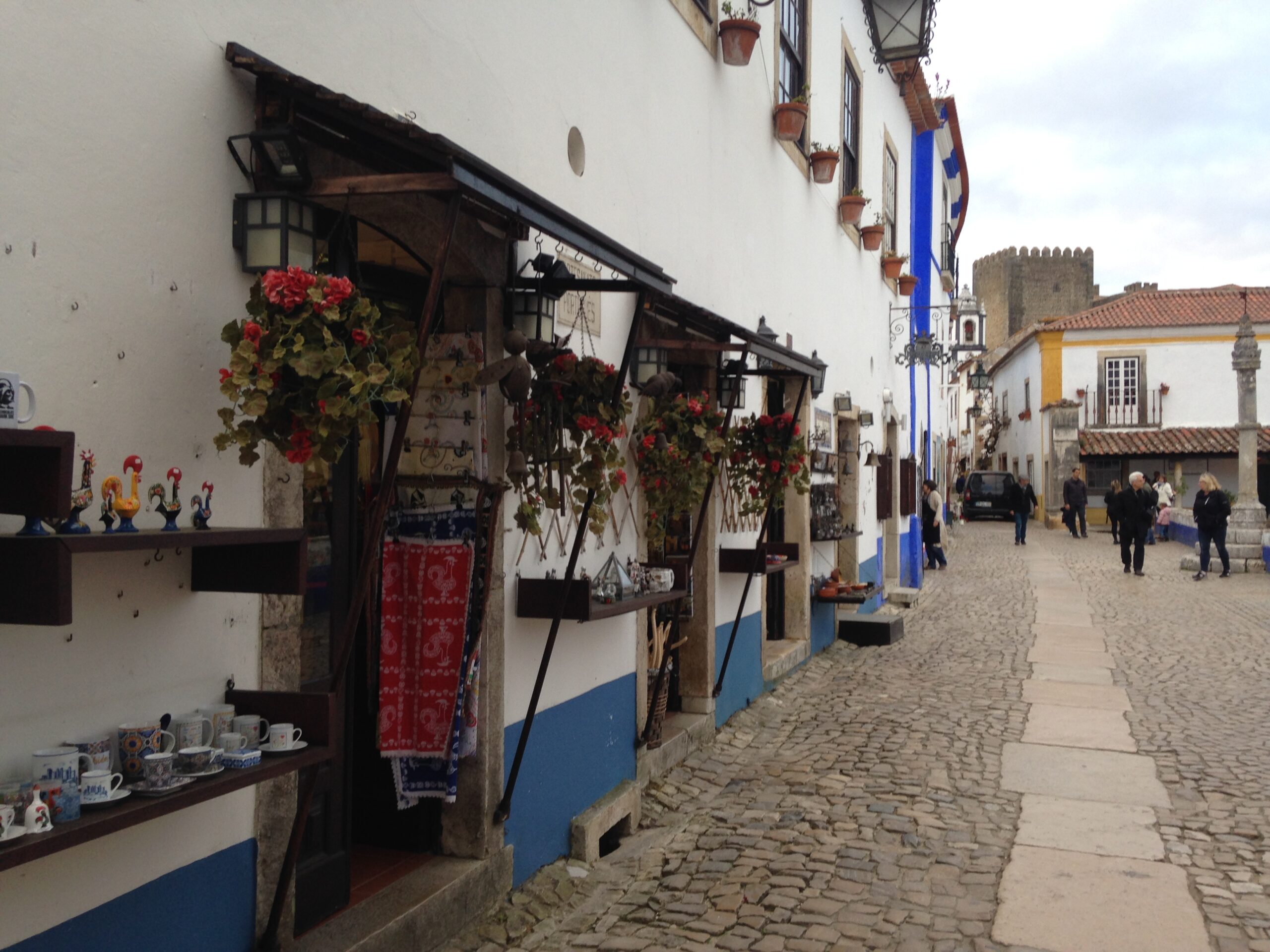

Tucked just an hour north of Lisbon, the hilltop town of Óbidos feels like something out of a storybook. It is a perfectly preserved medieval village enclosed by ancient stone walls, where every whitewashed home seems touched with bougainvillea or ivy. If you’re ever driving from Lisbon to Porto, this little gem is well worth a detour. We made the stop on a whim—and ended up walking through blooming wisteria, exploring castle walls, and staying overnight in our very own private castle.

Getting There: A Scenic Detour Worth Making
Reaching Óbidos from Lisbon is simple—just over an hour’s drive north via the A8 highway. Whether you’re renting a car for a longer road trip through Portugal or taking a break from the capital, the drive is easy, scenic, and well worth the mileage. As you approach, the sight of the walled city rising above the valley is breathtaking. It almost appears to be a stone crown set on a hilltop.
Parking is located just outside the town’s gates, which is part of the magic. Once you pass through the Porta da Vila, you step into another century.

Wandering the Walled Town
Óbidos is a place to explore slowly. The town itself is small—easily walkable in a few hours. But every cobbled alley, tiled fountain, and arched doorway invites you to linger. We were lucky enough to visit just as the ancient wisteria vines were in full bloom. Entire façades of buildings were draped in purple flowers, perfuming the air and casting a surreal, romantic glow on the narrow streets. It was absolutely stunning.
The houses are whitewashed with blue and yellow trim. Many of them date back hundreds of years, and the shops and cafés blend seamlessly into the historic feel. We browsed local crafts, tried the famed Ginjinha liqueur served in a chocolate cup, and simply wandered. Our eyes never quite knew where to land next.


A Town in Motion, Preparing for the Season
As we explored the streets during the day, we noticed that Óbidos wasn’t just a preserved medieval village—it was a living, breathing community. Locals were out and about, tending to their homes and shops with quiet purpose. We saw people repainting walls in fresh coats of whitewash, carefully trimming back the blooming wisteria, and checking in on neighbors from open windows or across the narrow lanes. It was clear the town was preparing for the busy tourist season ahead, but the energy felt communal, not commercial. And despite the activity, everyone had time for a smile, a “bom dia,” or a friendly nod. That simple hospitality gave the town a heartbeat—and made us feel, even if briefly, like part of it.
Living in a Castle (For Real)
One of the most unforgettable parts of our visit was where we stayed. We found a unique accommodation inside one of the old castle storehouses—a beautifully restored stone chamber with a massive greatroom all to ourselves.

The high, beamed ceilings, thick stone walls, and antique furnishings made it feel like we were living in our own private castle. And incredibly, we were the only guests there that night.

It was peaceful, atmospheric, and completely transportive. As the village lights dimmed and evening settled over the valley, we felt like the only people left behind in a dream.


The Queen’s Gift: A Love Story Written in Stone
The walls of Óbidos Castle rise like a dream. It’s hard to imagine that this fairytale village was once the stage for a royal love story that would help shape Portugal’s history.
In the 13th century, King Dinis I of Portugal—known as “the Farmer King” for his vision and love of the land—brought his young bride, Queen Isabel of Aragon, to visit this small fortified town. It was 1282, and Isabel had only recently arrived in Portugal, a teenage queen with a gentle nature and a growing reputation for compassion. When she saw the beauty of Óbidos—the sweeping views over vineyards and valleys, the castle standing proudly over the town—she fell completely in love with it.
Seeing her delight, King Dinis did something extraordinary: he gave her the entire town of Óbidos as a wedding gift. From that day forward, the castle and the village became known as “the Town of the Queens.” For centuries afterward, Óbidos would remain part of the personal estates of Portugal’s queens, passed down from one to the next as both a retreat and a symbol of royal affection.
Queen Isabel’s legacy lingers here. She was later canonized as Saint Isabel of Portugal, known for her acts of charity and the famous “Miracle of the Roses”—when she was caught secretly carrying bread to the poor, and the loaves miraculously turned into roses before the suspicious king’s eyes. Locals say the roses still bloom around Óbidos as a tribute to her kindness.
Today, when you walk the castle ramparts at sunset or wander through the quiet alleys scented with bougainvillea, it’s easy to imagine Isabel’s presence—her laughter echoing across the courtyard, her hand trailing along the ancient stone. The town remains a place of romance and poetry, and every festival, every glass of local ginjinha (cherry liqueur), feels like a continuation of her story.

Walking the Walls Above Town
No visit to Óbidos is complete without walking the medieval walls that completely encircle the town. You can climb up via several staircases just off the main street. Once you’re up there, the views are unbeatable: terracotta rooftops below, vineyards and rolling countryside beyond, and every twist of the wall offering a new perspective.
The walk takes about an hour if you do the full loop. Parts of the path are quite narrow with no guardrails—so it’s best for those comfortable with heights and sure footing. But it was truly a highlight. We did the full circle at golden hour, with the wisteria below and the sun casting a warm glow across the hills. It’s something we’ll never forget.

Final Thoughts: A Perfect Side Trip with Lasting Magic
Óbidos may be small, but it offers a rich, immersive glimpse into Portugal’s medieval past. But it doesn’t feel overly touristy or artificial. It’s a town that invites you to slow down, wander, and soak in centuries of history—while sipping sweet cherry liqueur and breathing in the scent of spring blooms.
Whether you stay for a few hours or a night, Óbidos leaves a lasting impression. If you’re traveling between Lisbon and Porto, don’t rush past. Take the scenic detour, walk the walls, breathe the wisteria, and live like royalty—if only for a day.